Refrigeration machines
Chillers
Produce chilled water and glycol mixtures for air conditioning and technological processes at large commercial and industrial facilities.
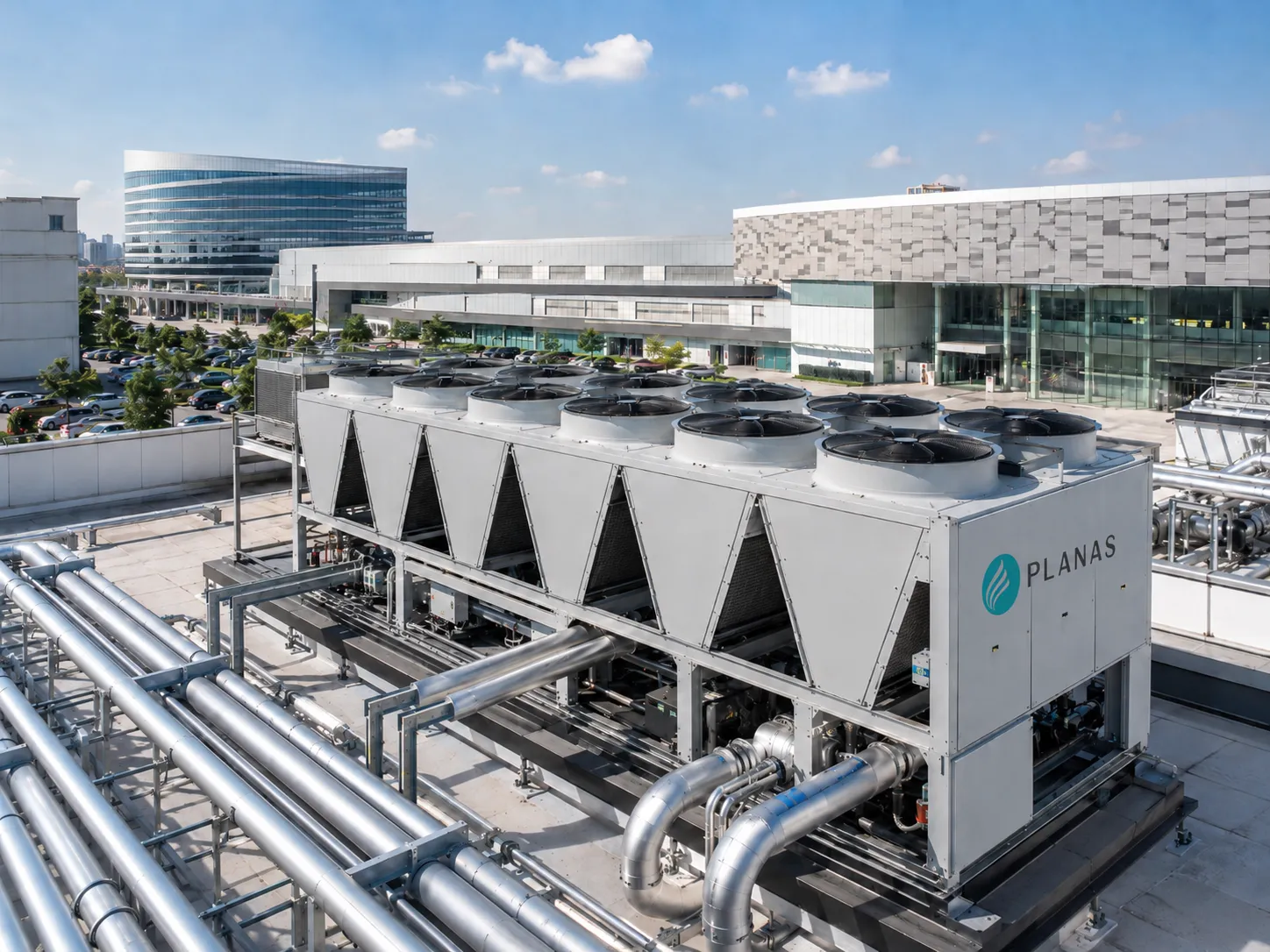
- Cooling capacityfrom 7 to 12 300 kW
- Cooling typesair and water
- Operating modescooling and heat pump
- Compressorsscroll, screw, centrifugal
- Applicationbusiness centers, shopping centers, hotels, factories, data centers
- Service lifemore than 15–20 years
Chillers
What is a chiller and how does it work
A chiller is a refrigeration machine that cools a liquid (water or water-glycol mixture) for subsequent distribution to consumers — fan coil units, central air conditioners, or process equipment.
Unlike conventional air conditioners, a chiller does not cool the air directly but produces a coolant that circulates through the system. This allows it to serve a large number of rooms from a single central unit.
The equipment is selected individually for each project — from ready-made models or custom-made. Thanks to this, chillers work effectively on facilities of any complexity: from business centers to large production lines.
Applications
Where chillers are used
Chillers are used in large facilities with many rooms or increased requirements for temperature stability.
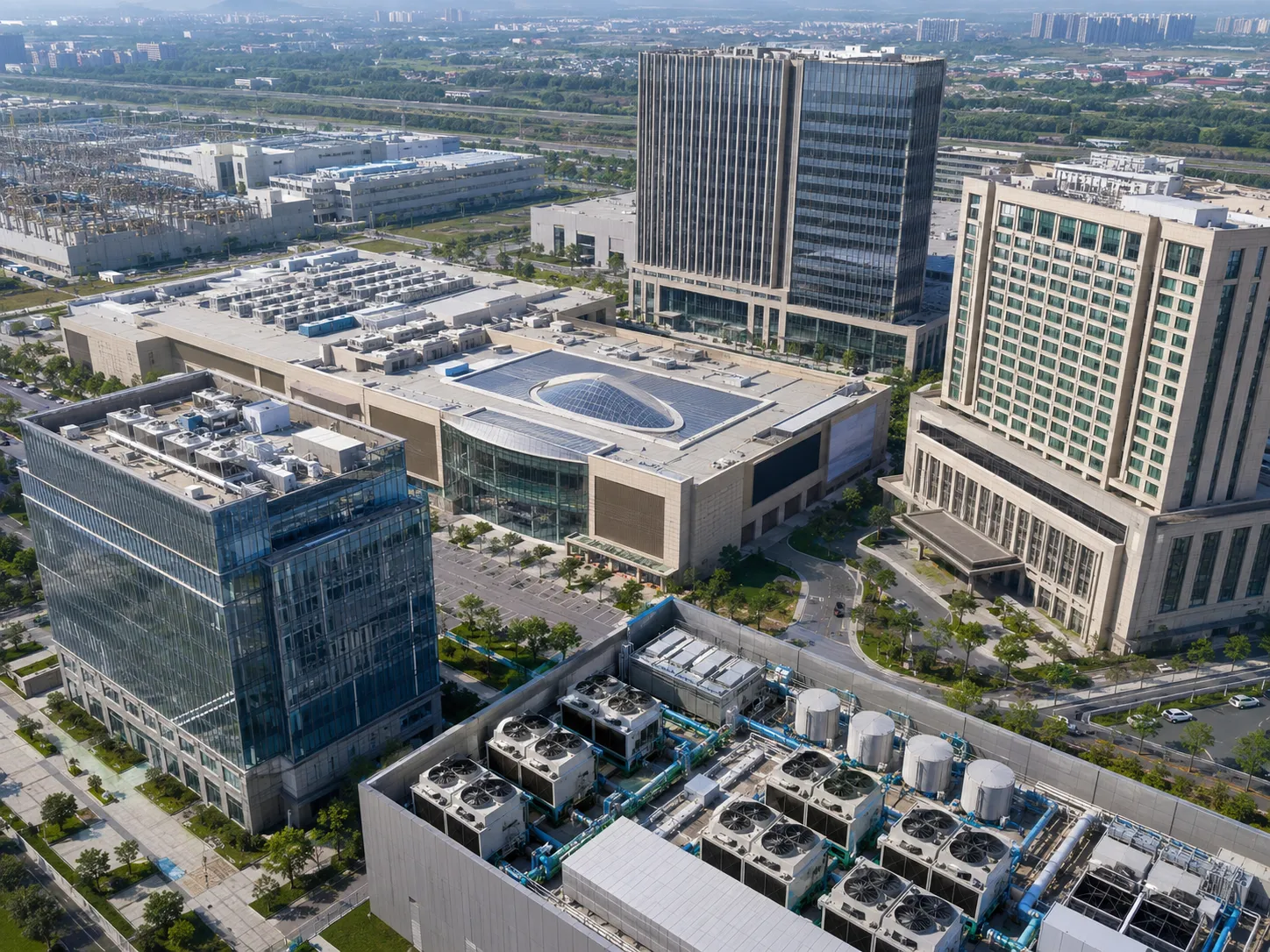
- 01Business centersCentralized air conditioning of office spaces of various sizes.
- 02Shopping centersMaintaining a set temperature in shopping halls and recreation areas.
- 03HotelsComfortable microclimate in rooms, halls and restaurants.
- 04Medical institutionsPrecise compliance with temperature conditions in operating rooms and wards.
- 05Sports facilitiesCooling of sports halls, swimming pools and auxiliary rooms.
- 06Manufacturing enterprises and technological linesCooling of technological processes and equipment.
- 07Warehouse complexesMaintaining temperature for storage of products with special requirements.
- 08Data centersHeat dissipation from server equipment to ensure uninterrupted operation.
Types and modifications
What types of chillers exist
Chillers are classified by condenser cooling method, design, operating mode, and compressor type.
Air cooling
Heat is dissipated to the outside air through fans. A simple solution for most commercial facilities.
Water cooling
Heat is dissipated through a cooling tower. High energy efficiency for large facilities.
Monoblock
All components in one housing. Supplied ready for installation, minimal commissioning time.
With remote condenser
The refrigeration circuit is split between the indoor unit and the outdoor condenser. For spaces with limited space.
Cooling only
Designed exclusively for cooling. Used with a separate heating system.
Heat pump
Work for cooling and heating. One unit all year round.
Scroll
Compact and reliable solution for medium power. Planas power: 7–600 kW. Series: PCAM (air-cooled), PCWM (water-cooled).
Screw
For large facilities with high loads. Planas power: 200–2250 kW. Series: PCAS (air-cooled), PCWS (water-cooled).
Centrifugal
Ultra-high cooling capacity. Planas power: 1759–12300 kW. Series: PCWC (water-cooled).
Operating principle
How a chiller works
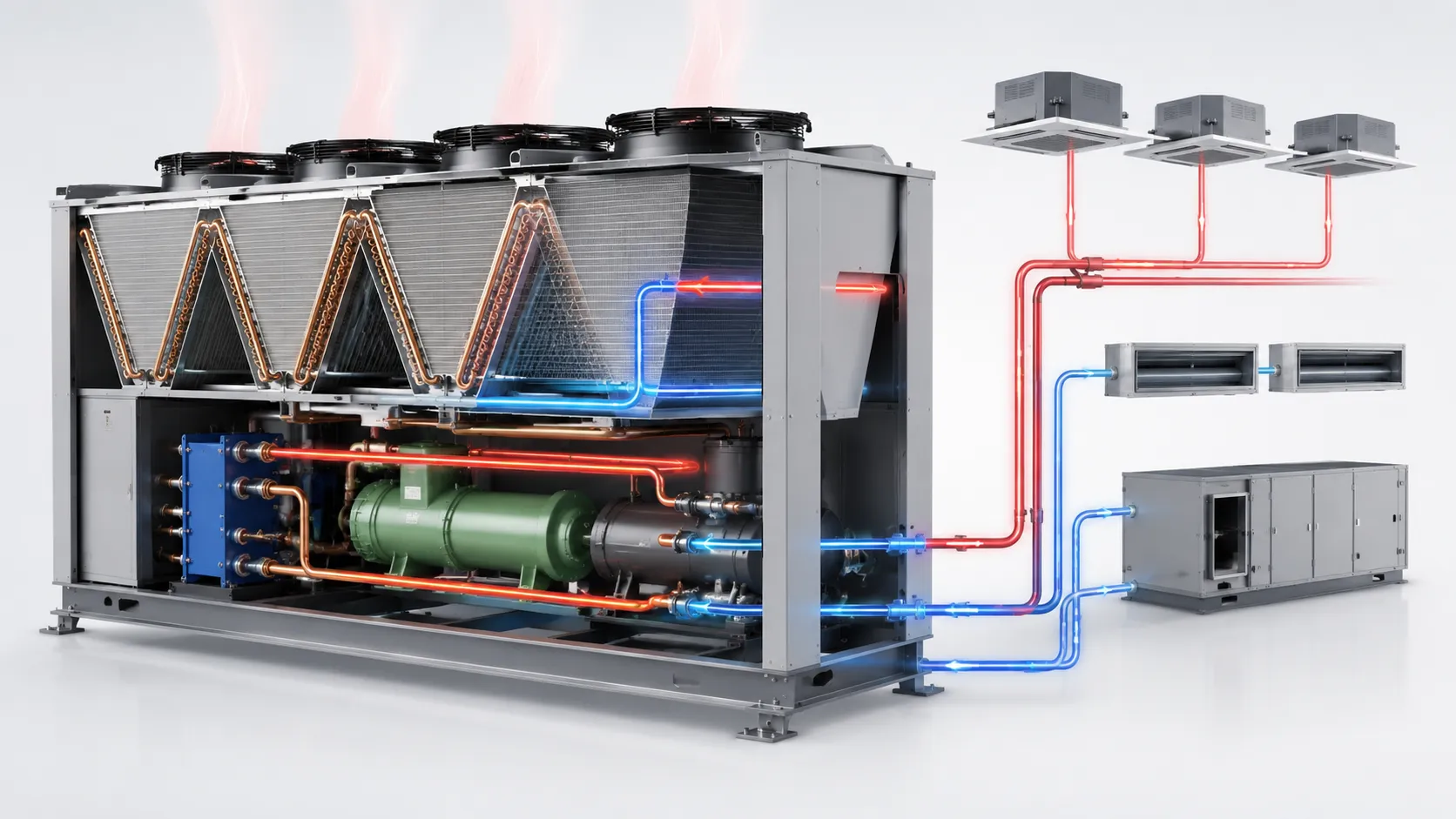
The cooling cycle consists of several stages ensuring continuous cold production.
01
Cooling of the coolant
In the chiller's evaporator, freon extracts heat from water or a water-glycol mixture, cooling it to a set temperature (usually +7…+12 °C).
02
Circulation to consumers
The cooled liquid is supplied through pipelines to fan coil units, central air conditioners, or technological installations.
03
Return of heated coolant
After releasing cold, the heated coolant returns to the chiller for re-cooling.
04
Heat removal in the condenser
The compressor compresses gaseous freon, and in the condenser (air or water) heat is removed from the system.
05
Automatic maintenance
The automation system continuously monitors temperature and maintains it at a set level.
Advantages
Why choose chillers
Chillers offer a number of advantages over traditional air conditioning systems.
01
High cooling capacity
Ability to create large volumes of cold for large facilities.
02
Maintenance of large facilities
One chiller can provide cooling for hundreds of rooms.
03
Design flexibility
Ability to adapt the system to any architecture and requirements.
04
Centralized air conditioning
Unified temperature control throughout the facility.
05
Cooling and heating operation
Heat pumps allow the equipment to be used all year round.
06
Energy efficiency
Modern compressors and circuits reduce energy consumption.
07
Scalability
The system can be expanded by adding new consumers.
08
Long service life
With proper maintenance, chillers operate for 15–20 years or more.
Equipment selection
Chiller selection criteria
The following factors are considered when selecting a chiller:
- Estimated cooling load of the facility (area, heat gains, number of people and equipment)
- Condenser cooling type: air-cooled or water-cooled
- Operating mode: cooling only or heat pump
- Compressor type: scroll, screw or centrifugal
- Installation conditions and available space
- Energy efficiency and operating cost requirements
- Delivery times and project budget

Support
Service and support Klimatrade
We help at all stages — from selection to commissioning.
- Individual selection of equipment for project tasks
- Technical consultations and assistance to designers
- Preparation of technical and commercial proposals
- Technical support at all stages of implementation
- Delivery through professional partners and installation organizations
Selection and supply of chillers for facilities of various purposes
Chillers are used in cooling systems for buildings, production lines and engineering infrastructure. An industrial chiller is suitable for manufacturing facilities, warehouses, commercial properties and buildings that require stable year-round cooling. This equipment can be used as a chiller for air conditioning, a chiller for production, a chiller for a business center, a chiller for a shopping center, a chiller for a hotel and a chiller for a data center.
Klimatrade specialists select chillers according to the facility parameters: heat load, temperature conditions, type of heat transfer fluid, operating conditions, connection scheme and energy efficiency requirements. Depending on the project, different types of chiller refrigeration machines can be selected: air-cooled chiller, water-cooled chiller, heat pump chiller, cooling-only chiller, packaged chiller or chiller with a remote condenser.
For facilities with different capacity requirements, a scroll chiller, screw chiller or centrifugal chiller may be used. To ensure efficient operation and avoid unnecessary costs, chiller capacity calculation is performed before equipment selection, along with clarification of installation, automation, operating mode and maintenance requirements.
If you are planning to buy a chiller for a facility in Kazakhstan, submit a request — we will calculate the parameters, select the equipment and prepare a commercial offer. The chiller price depends on cooling capacity, compressor type, condenser cooling method, configuration, automation and operating conditions.
Klimatrade supplies chillers in Kazakhstan for industrial, commercial and engineering facilities. Solutions are available for Almaty, Astana and other cities: chiller Almaty, chiller Astana and equipment delivery across Kazakhstan. Submit a request — our specialists will help you select a chiller for your facility’s needs.
Frequently asked questions
FAQ on chillers
Answers to popular questions about selecting and operating chillers.
What is a chiller?
A chiller is a refrigeration machine that produces chilled water for air conditioning systems and process cooling.
How does a chiller differ from an air conditioner?
An air conditioner supplies cooled air directly into the room, while a chiller cools a heat transfer fluid that is then used by other systems.
Where are chillers used?
In commercial, industrial, and infrastructure facilities: offices, shopping centers, hotels, factories, warehouses, and medical institutions.
Can a chiller be used in winter?
Yes. Many models are designed for year-round operation, and heat pumps can additionally operate in heating mode. However, the type of coolant should be considered to prevent freezing.
What is better: air or water cooling?
Air cooling is easier to install and maintain. Water cooling provides higher energy efficiency in large facilities.
How to select the chiller capacity?
The selection is made based on the calculated cooling load of the facility, taking into account the area, heat gains, number of people, equipment, and technological processes.
How long does a chiller last?
With regular maintenance, the service life of the equipment can exceed 15–20 years.
What are the delivery times for equipment?
The deadlines depend on the model, capacity, and configuration. To clarify equipment availability, please contact Klimatrade specialists.
Start the project
Ready to choose a chiller?
Leave a request, and our engineers will help you choose the optimal solution for your facility.